Expansion joints play a critical role in accommodating thermal movement and vibration in heat exchangers and piping systems. While metallic expansion joints are common in new installations, maintenance engineers often face situations where a direct replacemen is impractical due to space restrictions, welded assemblies, or the risk of damaging surrounding equipment. In such cases, clamshell expansion joints provide an effective retrofit alternative.
By Nelson Kavanagh, Ibere Souza, and Angelica Pajkovic, TEADIT
WHAT IS A CLAMSHELL EXPANSION JOINT?
Unlike conventional expansion joints, which are installed as a single prefabricated unit, a clamshell expansion joint is manufactured in segments, typically two halves (180° each) or more segments, which can be assembled around existing equipment in the field. Once positioned, the convolutions and connecting rings are welded together to form a complete expansion joint without requiring full disassembly of the piping system or heat exchanger. This approach minimizes the need to cut out large, welded sections, thereby reducing downtime, rework, and potential distortion caused by repeated cutting and rewelding of critical components.
WHEN TO USE A CLAMSHELL EXPANSION JOINT
Clamshell expansion joints are most often employed when:
• Complete equipment removal is impractical: For example, in large shell-and-tube heat exchangers with diameters exceeding 10 feet, cutting and reassembling welded sections can be prohibitively time-consuming.
• Shutdown duration must be minimized:
A full replacement may extend outages for weeks, while a clamshell installation can facilitate and expedite how soon a plant can resume its operations.
• Access limitations exist: When surrounding piping or internal tube bundles prevent safe removal of the original joint.
In these cases, plant engineers weigh the trade-off: a clamshell joint may have a reduced service life compared to a factory-welded expansion joint, but it can avoid extensive disassembly and significantly reduce downtime.
DESIGN CONSIDERATIONS
Clamshell expansion joints are application-specific and typically designed based on customer-provided drawings or field assessments.
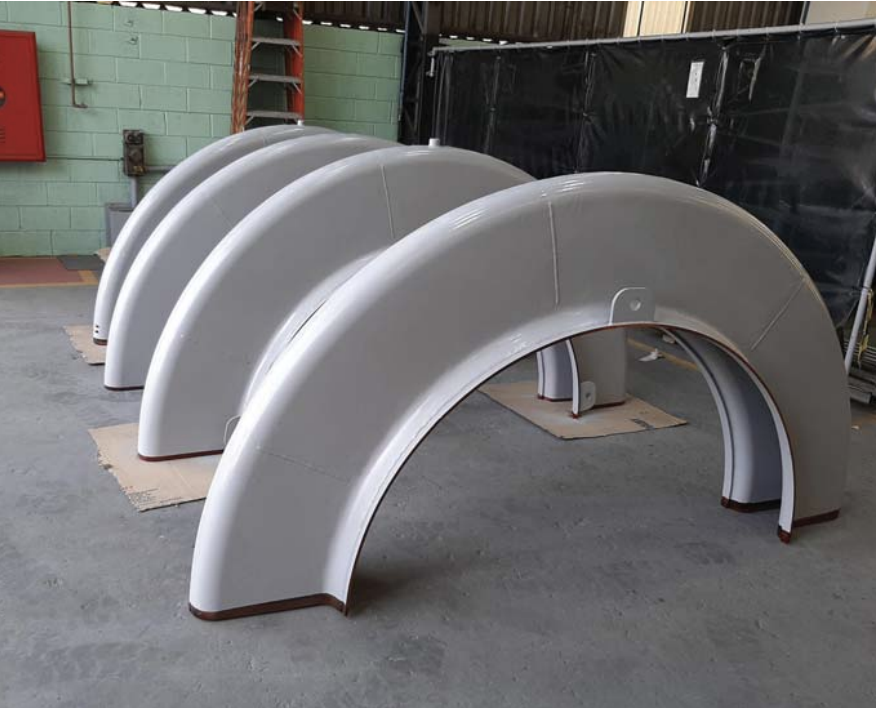
Carbon steel clamshell with a purge system.
Critical design factors include:
• Operating conditions: pressure, temperature, movement, and media.
• Materials of construction: ranging from carbon steel to stainless steels and nickel alloys such as Inconel, depending on the service environment.
• Segment configuration: halves or quadrants, depending on the diameter and installation constraints.
• Fabrication timeline: large clamshell joints may take more time than a new unit to design, fabricate, and prepare for shipment.
• Welding requirements: high-quality field welding is essential, particularly with alloys such as Inconel, which are sensitive to contamination and require inert gas shielding to avoid cracking.
INSTALLATION PRACTICES
Clamshell joints are often pre-assembled in the workshop for dimensional verification before being shipped in segments to the customer. On-site installation involves:
1. Positioning the clamshell sections precisely around the existing equipment.
2. Analyze the metal components to be joined and welded, taking into account qualified welding procedures. Preheating, post-weld heat treatment, or other special precautions may be required to ensure proper weld integrity.
3. Welding the bellows and connecting rings in sequence.
4. Using inert gas purging (typically argon) to protect root welds and ensure clean, defect-free joints.
5. Apply the proper NDE to inspect the welds and, if possible, consider a pressure test after final installation of the clamshell expansion joint.
Accuracy in alignment is critical. A mispositioning of the bellows welds can result in stress concentrations and premature failure. Precision during welding is particularly important when working with nickel alloys, as insufficient cleaning or purge protection can lead to cracks.
Depending on customer capabilities, installation may be carried out by plant personnel with technical guidance, or by the supplier’s field service team.
SERVICE LIFE AND LIMITATIONS
While effective, clamshell expansion joints do not typically achieve the same service life as factory-fabricated expansion joints. The reasons include:
• Weld quality differences: Shop-manufactured bellows use precision automatic seam welds that cannot be fully replicated in the field.
• Stress concentration: Retrofit welds may introduce localized stresses that reduce fatigue resistance.
•Reduced design flexibility: Multiplied (multi-ply) bellows are not feasible in clamshell configurations, limiting options for improved fatigue life. Segmenting the bellows makes it nearly impossible to achieve proper weld quality across all plies in a multi-ply design.
•Bellows size: It is necessary to consider a bellows with a convolution dimension that allows access to the torch welding process, to achieve the acceptable weld condition.
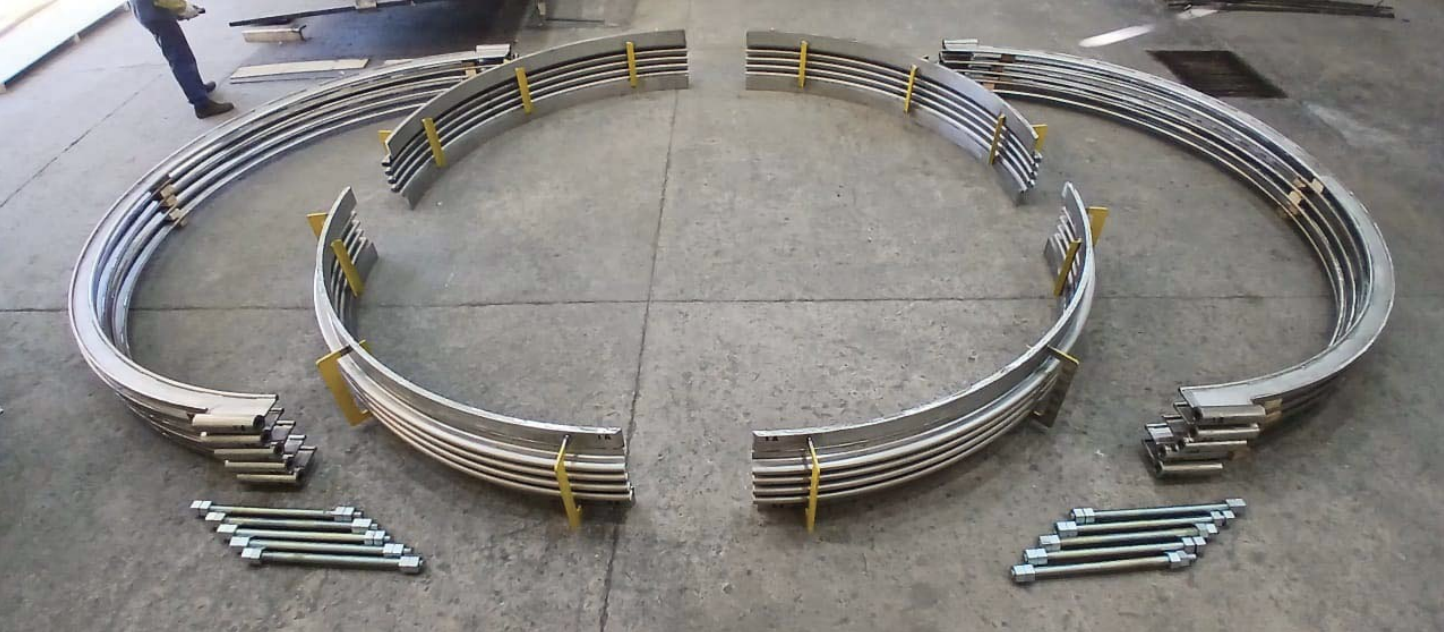
ND 140” clamshell made of Inconel 625 with reinforcing rings.
Despite these limitations, clamshell expansion joints often perform satisfactorily in low-cycle service. For example, in heat exchangers that operate continuously with only annual shutdowns, a clamshell may undergo fewer than 10 full thermal cycles over a decade, well within its functional limits.
STANDARDS AND QUALIFICATION
Although no dedicated standards exist specifically for clamshell expansion joints, the design and fabrication follow recognized industry codes:
• EJMA (Expansion Joint Manufacturers Association) guidelines for bellows design.
• ASME Section IX for welding procedure and welder qualification.
• ASME B31.3 governs welded repairs and tie-ins.
• API 660 for shell and tube heat exchangers in refineries and petrochemical services.
Engineering judgment remains essential when determining cut locations, weld preparation, and segment geometry, since these aspects are not standardized.
COMMON PITFALLS AND RECOMMENDATIONS
End users should be aware of several common issues:
• Overlapping with failed joints: Installing a clamshell over a leaking expansion joint without removing the failed bellows can increase reaction forces and risk further equipment damage.
• Poor weld quality: Contamination, lack of purge gas, or improper alignment during welding are leading causes of premature failure.
• Insufficient information provided: Incomplete drawings or missing operating condition data can delay design and fabrication.
To ensure reliable performance, users should:
• Provide complete operating and dimensional data during the design phase.
• Follow strict welding cleanliness and purge practices.
• Confirm bellows alignment prior to final welding.
• Verify pressure testing and safety relief valve capacity post-installation to ensure the system safely meets design pressure integrity requirements.
FINAL THOUGHTS
Clamshell expansion joints are not a replacement for new-build expansion joints. They are, however, an essential engineering workaround when equipment constraints or outage limitations make conventional replacement impractical. With careful design, precise installation, and adherence to welding best practices, clamshell joints provide a reliable retrofit solution that minimizes downtime and extends equipment service life, allowing for a planned shutdown to exchange for a definitive expansion joint.
As a global manufacturer and innovator in sealing and expansion joint technology, TEADIT® develops high-performance solutions engineered to support these critical applications, helping industries maintain operational integrity, reduce unplanned downtime, and ensure long-term reliability under demanding conditions.
About the Expert

Nelson Kavanagh is a mechanical engineer who has worked at Teadit Group for 40 years. During this period, he gained significant experience in engineering many products. His particular focus is on designing, developing, and manufacturing processes of expansion joints. He is a member of the EJMA technical committee and is dedicated to continuously improving the EJMA standard.

Iberê Souza has a bachelor’s degree in Mechanical Engineering from the State University of Campinas (UNICAMP), Brazil. Born and raised in Brazil, he’s been living in the USA for the past ten years, where he deepened his knowledge of Quality Management Systems and ISO 9001 standards. Iberê recently transitioned to a technical market support position to develop and bring expansion joint solutions to the industry. He is currently the Expansion Joint Market Support Specialist at Teadit.
About the Author

Angelica Pajkovic is a Client Specialist at Teadit, with a particular focus on technical content development. Hailing from Toronto, Canada, she has over six years of experience in the industrial industry. In her previous role as Editor-in-Chief at an industrial B2B Publishing company, she gained a rounded understanding of the challenges, interests, and business relationships in the industrial sector. For more information, please contact Angelica via email at:angelicap@teadit.com.