Why manufacturing matters to seal integrity.
By Mayara Calderaro
Polytetrafluoroethylene (PTFE) sheet gasketing has long been a go-to sealing solution for industries requiring broad chemical resistance and versatility across a wide range of services. From chemical processing to refining and power generation, PTFE’s inert nature makes it attractive for use in applications with aggressive media where traditional materials may struggle.
Despite sharing the same base polymer, not all PTFE sheets are created equal. Once installed, a PTFE gasket’s behavior, and by extension, sealing ability, can vary depending on its manufacturing and composition.
As operational conditions become more demanding, plant engineers are increasingly subjected to applications that experience premature leakage and loss of sealing stress in PTFE-based gaskets. These challenges are no longer just maintenance concerns.
Regulatory frameworks such as leak detection and repair (LDAR) programs and Benzene Waste Operations NESHAP (BWON) consent decrees have underscored the importance of sealing integrity, as minor decreases in gasket stress can contribute to measurable fugitive emissions and associated compliance concerns.
While the stem of these issues is often attributed to gasket creep, the reality is more complex. The manufacturing method and filler content significantly influence how PTFE performs under load, temperature and time. To better understand these differences, restructured-filled PTFE sheets were compared with conventional skived-filled PTFE sheets to evaluate their structure and stress-relaxation performance over time.
Structure Differences
At first glance, most PTFE sheets appear similar: they share chemical resistance and visual appearance and have comparable tensile strength values on datasheets. However, their microstructures reveal differences that can affect sealing performance in demanding applications.
Traditional skived PTFE sheets begin as compression-molded and sintered PTFE billets. Thin sheets are mechanically sliced from the solid block, yielding continuous films of controlled thickness in a process known as skiving. The compression molding and subsequent sintering produce a microstructure in which the polymer chains remain largely disoriented, and the material lacks a fibrillar network. As a result, skived PTFE exhibits cold flow under sustained compressive load, leading to reduced dimensional stability at both ambient and elevated temperatures.
Restructured PTFE (rPTFE) sheets follow a different processing route. Instead of being produced from molded billets, PTFE resin is mechanically fibrillated through biaxial lamination. This process forms a highly oriented network of PTFE fibrils, effectively distributing compressive loads throughout the structure and improving creep resistance.
Inorganic fillers such as glass fiber, glass microspheres, barite and silica are commonly incorporated into PTFE to enhance stiffness, reduce creep and improve dimensional stability. Although the PTFE matrix remains chemically unchanged, the inclusion of these fillers substantially modifies the material’s mechanical behavior under compressive load.
The manufacturing process governs the final microstructure of the PTFE, while interactions between PTFE and filler characteristics (including morphology, particle size and distribution) influence fibrillation, porosity, density and mechanical behavior.
What Chemical Analysis Revealed
Laboratory testing validated how different these materials are. For comparison, a skived PTFE and an rPTFE sheet were tested; both contained glass filler.
Density measurements indicated that the skived-filled PTFE sheet averaged 2.09 grams per cubic centimeter (g/cm³), while the restructured-filled PTFE sheet averaged 1.46 g/cm³. The notable difference in density between the materials can be attributed to the combined effects of filler morphology, filler loading and the less compact microstructure resulting from the PTFE restructuring process.
Thermogravimetric analysis (TGA) provided further insight into composition. The skived-filled material exhibited an inorganic filler content of 20%-30% by mass. In contrast, the restructured-filled PTFE had a filler content of 10%-20%.
Differential scanning calorimetry (DSC) revealed similar thermal transition profiles for both materials, indicating that the observed differences in mechanical performance arise from microstructural orientation and filler content rather than polymer sintering quality.
Compressibility
When tested for compressibility using American Society for Testing and Materials (ASTM) F36M methodology, the differences between the materials became even more apparent. The restructured-filled PTFE sheet demonstrated approximately 3.5 times greater compressibility than the skived-filled PTFE composite, as shown in Image 1.
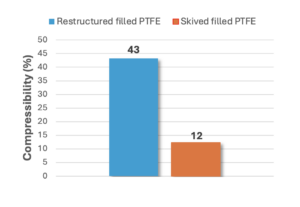
IMAGE 1: Comparison of compressibility between restructured and skived PTFE sheets (Images courtesy of TEADIT).
The higher compressibility of the restructured-filled PTFE, combined with its low density, corroborates the presence of a less compact microstructure. This characteristic is important in bolted flange joints, as greater compressibility enables the gasket to conform more closely to surface irregularities, machining marks and minor flange distortions. It also helps maintain an effective seal by accommodating uneven bolt loads and compensating for gasket and bolting relaxation that can occur during service.
Elevated Temperature
Creep behavior of the materials was evaluated in accordance with DIN 52913 at both room temperature and 302 F (150 C). The materials were subjected to an initial gasket stress of 30 megapascals (MPa) to assess the influence of temperature on their time-dependent deformation.
Short-term stress retention testing at room temperature revealed only minor differences between the two materials. Testing under these conditions established a baseline for mechanical stability, as restricted molecular mobility limits viscoelastic relaxation, reducing the impact of microstructural variations introduced during manufacturing.
When tested at elevated temperature, the performance of the two materials diverged significantly.
Although the skived-filled PTFE contained a higher filler loading, which is commonly used to improve creep resistance by limiting polymer chain movement and enhancing load transfer, it exhibited faster stress relaxation at elevated temperatures. This finding demonstrates that filler content alone does not determine high-temperature performance in PTFE composites.
By comparison, the rPTFE maintained approximately 25% higher sealing stress than the skived material (Image 2), indicating superior stress retention under elevated-temperature conditions. The improved performance is attributed to the biaxial lamination process, which creates a highly oriented, cross-fibrillated microstructure that enhances long-term mechanical stability.
Elevated-temperature testing accelerates viscoelastic relaxation, making material performance more dependent on the internal structure developed during manufacturing. Evaluating both room-temperature and elevated-temperature behavior, therefore, provides a more complete understanding of how processing methods influence the long-term sealing performance of PTFE-based composites under service conditions.
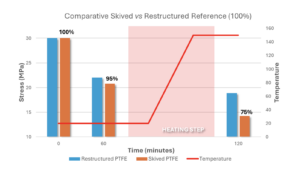
IMAGE 2: Comparative stress relaxation behavior of skived PTFE and rPTFE sheets at elevated temperature (DIN 52913).
The Bigger Industry Picture
The results from material comparisons demonstrate that initial sealing performance alone is not a reliable indicator of long-term gasket reliability. While many PTFE gaskets provide an adequate seal at assembly, stress relaxation over time, especially under thermal cycling conditions, can reduce sealing load. The manufacturing process and resulting material structure have a major role in determining long-term sealing performance.
In general, skived PTFE materials are more cost-effective and experience higher creep rates under sustained load. Biaxially oriented and fibrillated PTFE structures, on the other hand, generally demonstrate superior resistance to cold flow and creep, along with higher compressibility, thereby improving sealing reliability, particularly in applications involving thermal cycling.
In practice, this means that material selection is not only a matter of composition, but of how the material is processed and structured; the microstructure determines how well a gasket will perform over time under real operating conditions.
What This Means for Plant Reliability
In operating environments, flange joints are exposed to repeated thermal cycles, pressure fluctuations and imperfections in the sealing surfaces. Excessive material relaxation can result in the gaskets losing sealing stress over time, potentially leading to:
- Fugitive emissions
- Leakage
- Retorque requirements
- Increased maintenance costs
- Premature gasket replacement
- Improved gasket conformity to flange surface imperfections
- Higher residual sealing stress throughout service life
- Enhanced resistance to creep and viscoelastic relaxation
- Increased long-term sealing integrity and operational reliability
The increased stress retention of rPTFE highlights the importance of microstructural design in evaluating sealing solutions for demanding service conditions. By maintaining sealing load more effectively under elevated temperatures, these materials can help support longer service intervals, improved equipment reliability and reduced emissions risk.
A deeper understanding of how material processing influences performance will become increasingly important as sealing systems continue to play a larger role in operational efficiency and environmental compliance. Future gasket selection strategies will likely place greater emphasis on performance-driven material design, recognizing that long-term sealing integrity begins at the microstructural level.
References
- Veiga, J. Industrial Gaskets: Principles, Design, and Applications. TEADIT, Brazil.
- Ebnesajjad, S. Fluoroplastics, Volume 1: Non-Melt Processible Fluoroplastics. William Andrew Publishing, 2014.
- TEADIT Research & Engineering Chemical Laboratory. External Technical Report BTE032,033,062/23: Composition, Density, and Thermal Analysis of PTFE Sheet Materials, February 2023.
- ASTM F36-15. Standard Test Method for Compressibility and Recovery of Gasket Materials. West Conshohocken, PA: ASTM International, 2015.
- DIN 52913:2002-04. Testing of static gaskets for flange connections – Compression creep testing of gaskets made from sheets.
- TEADIT Research & Engineering Laboratory. Technical Report RT 2808C: Mechanical and Creep Performance Comparison of Restructured PTFE and Filled Skived PTFE Sheet, May 2023.
 About the Author
Mayara Calderaro is a chemist with a Master’s and Ph.D. in Chemical Engineering from the State University of Campinas (UNICAMP), specializing in polymeric materials, sustainable technologies, and industrial innovation. With over a decade of experience in Research and Development, she has built a career integrating science, engineering, and business, transforming advanced technical knowledge into high-performance solutions for industrial applications. She is currently the Research and Development Lead at TEADIT Brazil. .