Industrial chemical plants frequently require flat gaskets in dimensions that exceed standard sheet sizes. These large-diameter connections, typically above 1500 mm or 60” in diameter, are often found in reactors, storage vessels, columns, electrolysers, and other critical equipment where sealing reliability directly impacts safety, environmental compliance, and uptime.
When addressing large gasket applications, plant personnel often ask what the most reliable manufacturing approach is for large PTFE gaskets in chemical applications, and how it compares to alternative joining methods in terms of sealing performance and practicality.
Selecting a gasket that can maintain tightness, simplify installation, and support long-term reliability in demanding plant conditions requires a clear understanding of how available manufacturing technologies and material choices address the mechanical and operational challenges associated with large-diameter flanged joints in chemical service.
By Julia Köder, Oliver Zach, and Angelica Pajkovic, TEADIT®
Why Large-Diameter Gaskets Are Considered Critical Applications
Large-diameter flange connections present unique mechanical and sealing challenges compared with smaller bolted joints. As flange diameter increases, the total separating force generated by internal pressure rises significantly, even at relatively low pressures. Maintaining an adequate, uniform bolt load across the entire flange is essential to preserve gasket compression and prevent leakage.
These joints are also frequently exposed to thermal cycling and differential thermal expansion between connected components. Equipment constructed from different materials can experience relative movement during temperature changes, introducing transverse stresses that may reduce local gasket stress and compromise sealing integrity.
In addition, manufacturing tolerances and surface irregularities become more pronounced in large equipment. Flange flatness deviations and dimensional variations require gasket materials with sufficient compressibility and adaptability to conform to the sealing surfaces and maintain tightness.
For these reasons, large-diameter applications require gasket materials that combine chemical resistance with controlled compressibility and compensation capability. PTFE-based gasket materials are well-suited to these conditions, as they can adapt to flange imperfections while maintaining resistance to aggressive chemical environments. However, the method used to manufacture and assemble large gaskets has a decisive influence on long-term sealing reliability.
The minimum recommended gasket thickness for large-diameter applications is typically 3 mm or 1/8”, depending on required compensation capacity and permissible gasket stress. Operating pressure, temperature, and media compatibility must always be evaluated, and the material's maximum allowable gasket stress must be verified for the specific application.
Restructured PTFE Sheet Gaskets: Welded Construction
For restructured PTFE (rPTFE) sheet materials, welding is the recommended manufacturing method for large diameters. However, to ensure consistent repeatability and uniform weld thickness, the correct machining technique is of paramount importance. At TEADIT® a proprietary technology is utilized to halve the gasket at its midpoint and join it together with a puzzle-like connection.
The fused connection creates a homogeneous joint that, when executed precisely, achieves leakage performance comparable to that of a gasket made from a single piece. Testing according to EN13555 demonstrates that leakage rates of welded gaskets are on the same level as one-piece constructions.
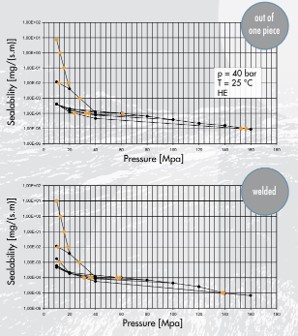
Figure 1: Comparison sealability test for 2mm thick Tealon® TF1580 according to EN13555.
In contrast, mechanically joined segment designs, such as dovetail or buttonhole connections, although widely used, cannot match the technical quality of a properly welded joint. While they may function acceptably when executed correctly, they introduce geometrical discontinuities that can affect sealing integrity under stress and thermal movement.
How fusing solves the issue:
An additional operational benefit is logistics. Welded gaskets can be delivered rolled in compact packaging, reducing transport space and simplifying handling at the site. Installation can be performed without delay, provided the weld is continuous and free of gaps or missing material.
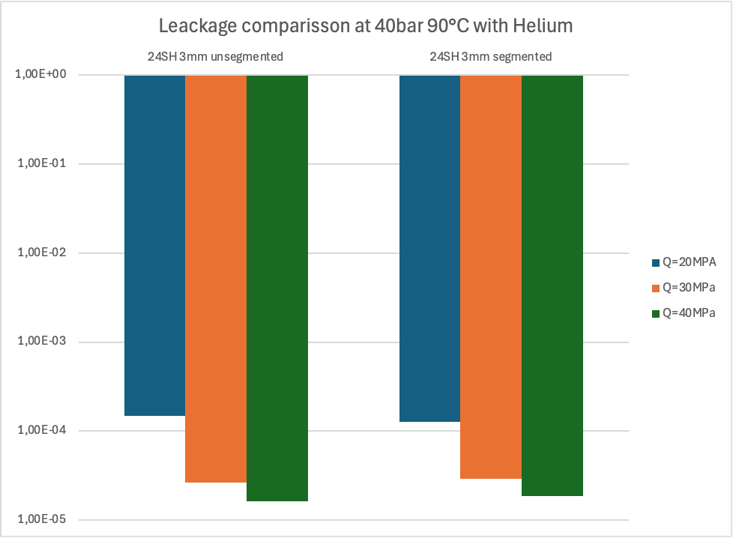
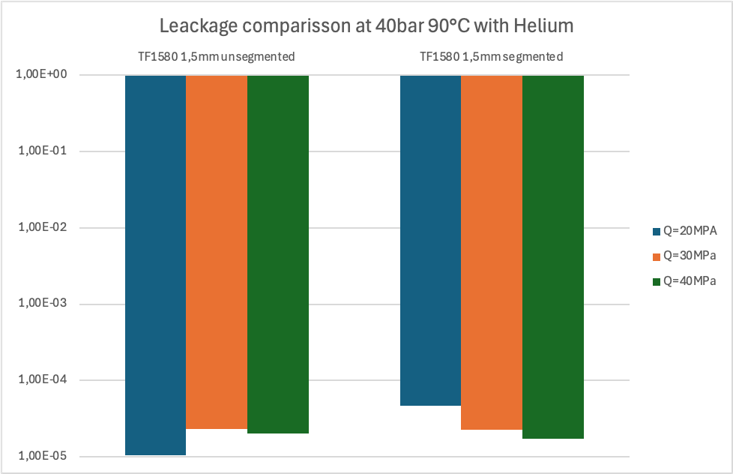
Figure 2 and 3: Leakage comparison test.
Multidirectional Expanded PTFE Sheet Gaskets: Cut and Bonded Segments
Expanded PTFE (ePTFE) sheet materials behave differently from restructured PTFE (rPTFE) during welding, as the weld zone can harden disproportionately, potentially compromising performance. For this reason, TEADIT® has not adopted welding for ePTFE materials. In practice, achieving consistently reliable joints in ePTFE has proven extremely difficult, and a robust welding method that ensures dependable connections has not been identified. While some manufacturers employ welded ePTFE solutions, many manufacturers choose not to use this approach due to the challenges in maintaining consistent material integrity and joint quality.
For large-diameter gaskets manufactured from ePTFE sheets, the recommended method is TEADIT®’s patent-pending technique. In this process, the gasket is partially cut into interlocking segments that form a precision “puzzle-type” or finger joint geometry. The mating edges are shaped so that the two sections mechanically engage, increasing the effective bonding area and preventing relative movement during handling and installation. The joint is then secured using a compatible adhesive, creating a continuous gasket while maintaining dimensional stability. This approach is conceptually similar to the method used for rPTFE; however, unlike rPTFE, the ePTFE segments are bonded rather than fused.
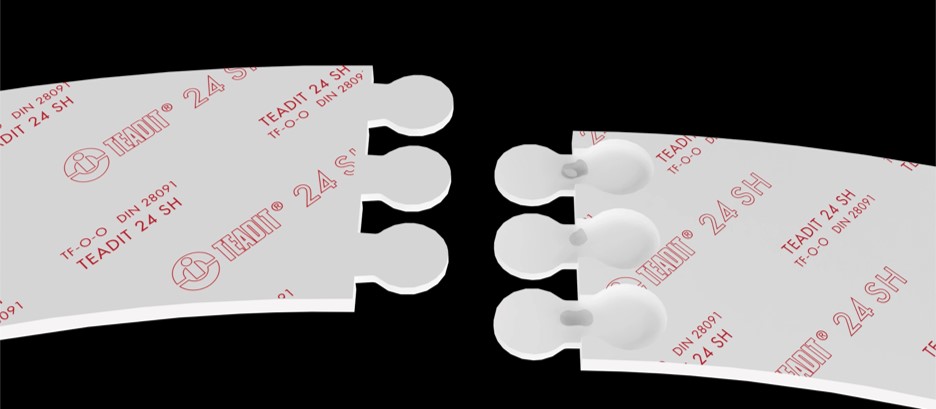
Testing shows that leakage rates of properly overlapped bonded segments are comparable to those of one-piece gaskets. By contrast, double dovetail designs demonstrate significantly higher leakage rates.
How ePTFE solves the issue:
Segments may be supplied pre-cut (not recommended) or as fully bonded assemblies.
This design significantly simplifies transportation by allowing the gasket to be handled in sections; however, on-site installation becomes more complex due to the need to accurately align and assemble the joints. To improve transport stability while facilitating installation, duplicate segments with staggered (offset) joint locations can be supplied, preventing the connection points from aligning in the same circumferential position and thereby enhancing structural integrity during handling and assembly.
Multidirectional ePTFE Sealing Tape: Single-Joint Construction
For the fastest and simplest production of large-diameter gaskets, multidirectional ePTFE sealing tape offers a distinct advantage.
Unlike segmented sheet constructions, tape-based gaskets require only a single joint for flanges up to 30m in diameter. This significantly reduces the number of potential leak paths. The mechanical characteristics of the tape are comparable to those of multidirectional ePTFE sheet materials, and its leakage performance is comparable to that of one-piece sheet gaskets.
How ePTFE Tapes solve the issue:
Skiving is performed with a sharp knife, with approximately 18 mm overlap for 3 mm thickness. Used tapes can be removed cleanly without residue, facilitating maintenance turnarounds.
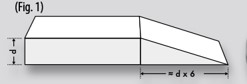
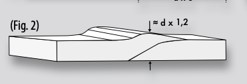
Figure 4: Segment and connection recommendation.
An additional advantage is the flexibility it provides in repair situations. Extra layers can be applied locally as shims to compensate for flange damage or surface irregularities. It is also highly beneficial for connections involving mixers or other equipment where installing a conventional gasket is not feasible without demounting the mixer or other equipment.
For maintenance teams working under time constraints, such as during shutdowns or emergency repairs, ePTFE tape provides:
It is particularly advantageous when handling large sheets or precise segment alignment would be time-consuming.
Selecting the Appropriate Approach for Your Facility
When evaluating large-diameter PTFE gasket solutions in a chemical processing plant, the decision should consider:
In summary:
Each of the described methods addresses the core challenge of large-diameter sealing: maintaining uniform stress distribution and tightness despite thermal movement, transverse forces, and manufacturing tolerances.
For chemical plant personnel responsible for equipment reliability, understanding the specific benefits of each manufacturing approach allows informed selection aligned with plant operating conditions, maintenance strategy, and safety objectives.
ReferencesTop of Form
 About the Expert
Julia Köder is an Application Engineer at TEADIT International Produktions GmbH. Her responsibilities include providing technical consultation to clients, conducting training sessions, and offering support for technical inquiries. Before taking on this role in July 2022, Julia worked as a project engineer in the automotive section, a position she held from October 2019 after completing her master’s degree in mechanical engineering. During that time, she gained significant experience managing global engineering projects, overseeing both local and international operations, and spearheading the procurement of machinery and the installation of test and prototype facilities.
 About the Expert
Oliver Zach is the Managing and Commercial Director of TEADIT International Produktions GmbH. A mechanical engineer and sealing industry expert, he began his career at SGL Group in 1995, supporting chemical industry applications during the transition from asbestos-based materials. He later spent 10 years in sales and management roles across Asia before joining the TEADIT Group in 2011.
 About the Author
Angelica Pajkovic is a Client Specialist at Teadit, with a particular focus on technical content development. Hailing from Toronto, Canada, she has over six years of experience in the industrial industry. In her previous role as Editor-in-Chief at an industrial B2B Publishing company, she gained a rounded understanding of the challenges, interests, and business relationships in the industrial sector. For more information, please contact Angelica via email at: angelicap@teadit.com.
When addressing large gasket applications, plant personnel often ask what the most reliable manufacturing approach is for large PTFE gaskets in chemical applications, and how it compares to alternative joining methods in terms of sealing performance and practicality.
Selecting a gasket that can maintain tightness, simplify installation, and support long-term reliability in demanding plant conditions requires a clear understanding of how available manufacturing technologies and material choices address the mechanical and operational challenges associated with large-diameter flanged joints in chemical service.
By Julia Köder, Oliver Zach, and Angelica Pajkovic, TEADIT®
Why Large-Diameter Gaskets Are Considered Critical Applications
Large-diameter flange connections present unique mechanical and sealing challenges compared with smaller bolted joints. As flange diameter increases, the total separating force generated by internal pressure rises significantly, even at relatively low pressures. Maintaining an adequate, uniform bolt load across the entire flange is essential to preserve gasket compression and prevent leakage.
These joints are also frequently exposed to thermal cycling and differential thermal expansion between connected components. Equipment constructed from different materials can experience relative movement during temperature changes, introducing transverse stresses that may reduce local gasket stress and compromise sealing integrity.
In addition, manufacturing tolerances and surface irregularities become more pronounced in large equipment. Flange flatness deviations and dimensional variations require gasket materials with sufficient compressibility and adaptability to conform to the sealing surfaces and maintain tightness.
For these reasons, large-diameter applications require gasket materials that combine chemical resistance with controlled compressibility and compensation capability. PTFE-based gasket materials are well-suited to these conditions, as they can adapt to flange imperfections while maintaining resistance to aggressive chemical environments. However, the method used to manufacture and assemble large gaskets has a decisive influence on long-term sealing reliability.
The minimum recommended gasket thickness for large-diameter applications is typically 3 mm or 1/8”, depending on required compensation capacity and permissible gasket stress. Operating pressure, temperature, and media compatibility must always be evaluated, and the material's maximum allowable gasket stress must be verified for the specific application.
Restructured PTFE Sheet Gaskets: Welded Construction
For restructured PTFE (rPTFE) sheet materials, welding is the recommended manufacturing method for large diameters. However, to ensure consistent repeatability and uniform weld thickness, the correct machining technique is of paramount importance. At TEADIT® a proprietary technology is utilized to halve the gasket at its midpoint and join it together with a puzzle-like connection.
The fused connection creates a homogeneous joint that, when executed precisely, achieves leakage performance comparable to that of a gasket made from a single piece. Testing according to EN13555 demonstrates that leakage rates of welded gaskets are on the same level as one-piece constructions.
Figure 1: Comparison sealability test for 2mm thick Tealon® TF1580 according to EN13555.
In contrast, mechanically joined segment designs, such as dovetail or buttonhole connections, although widely used, cannot match the technical quality of a properly welded joint. While they may function acceptably when executed correctly, they introduce geometrical discontinuities that can affect sealing integrity under stress and thermal movement.
How fusing solves the issue:
- Maintains consistent sealing performance across the entire circumference
- Avoids stress concentrations at mechanical joints
- Preserves tightness class equivalent to one-piece construction gaskets
- Allows exact dimensional control by the manufacturer
An additional operational benefit is logistics. Welded gaskets can be delivered rolled in compact packaging, reducing transport space and simplifying handling at the site. Installation can be performed without delay, provided the weld is continuous and free of gaps or missing material.
Figure 2 and 3: Leakage comparison test.
Multidirectional Expanded PTFE Sheet Gaskets: Cut and Bonded Segments
Expanded PTFE (ePTFE) sheet materials behave differently from restructured PTFE (rPTFE) during welding, as the weld zone can harden disproportionately, potentially compromising performance. For this reason, TEADIT® has not adopted welding for ePTFE materials. In practice, achieving consistently reliable joints in ePTFE has proven extremely difficult, and a robust welding method that ensures dependable connections has not been identified. While some manufacturers employ welded ePTFE solutions, many manufacturers choose not to use this approach due to the challenges in maintaining consistent material integrity and joint quality.
For large-diameter gaskets manufactured from ePTFE sheets, the recommended method is TEADIT®’s patent-pending technique. In this process, the gasket is partially cut into interlocking segments that form a precision “puzzle-type” or finger joint geometry. The mating edges are shaped so that the two sections mechanically engage, increasing the effective bonding area and preventing relative movement during handling and installation. The joint is then secured using a compatible adhesive, creating a continuous gasket while maintaining dimensional stability. This approach is conceptually similar to the method used for rPTFE; however, unlike rPTFE, the ePTFE segments are bonded rather than fused.
Testing shows that leakage rates of properly overlapped bonded segments are comparable to those of one-piece gaskets. By contrast, double dovetail designs demonstrate significantly higher leakage rates.
How ePTFE solves the issue:
- The interlocking half-cut “puzzle” joint, formed with skived overlapping sections, maintains uniform gasket thickness across the connection, ensuring that gasket stress is distributed evenly around the entire circumference.
- High compressibility of the material makes the method forgiving during installation
- Minimizes the formation of leakage paths caused by creep under gasket stress
Segments may be supplied pre-cut (not recommended) or as fully bonded assemblies.
This design significantly simplifies transportation by allowing the gasket to be handled in sections; however, on-site installation becomes more complex due to the need to accurately align and assemble the joints. To improve transport stability while facilitating installation, duplicate segments with staggered (offset) joint locations can be supplied, preventing the connection points from aligning in the same circumferential position and thereby enhancing structural integrity during handling and assembly.
Multidirectional ePTFE Sealing Tape: Single-Joint Construction
For the fastest and simplest production of large-diameter gaskets, multidirectional ePTFE sealing tape offers a distinct advantage.
Unlike segmented sheet constructions, tape-based gaskets require only a single joint for flanges up to 30m in diameter. This significantly reduces the number of potential leak paths. The mechanical characteristics of the tape are comparable to those of multidirectional ePTFE sheet materials, and its leakage performance is comparable to that of one-piece sheet gaskets.
How ePTFE Tapes solve the issue:
- Rapid on-site fabrication
- Self-adhesive backing simplifies positioning and installation over head
- Only one overlapping joint
- Height in the joint area adjusted to approximately 120% of tape thickness to ensure proper compression
Skiving is performed with a sharp knife, with approximately 18 mm overlap for 3 mm thickness. Used tapes can be removed cleanly without residue, facilitating maintenance turnarounds.
Figure 4: Segment and connection recommendation.
An additional advantage is the flexibility it provides in repair situations. Extra layers can be applied locally as shims to compensate for flange damage or surface irregularities. It is also highly beneficial for connections involving mixers or other equipment where installing a conventional gasket is not feasible without demounting the mixer or other equipment.
For maintenance teams working under time constraints, such as during shutdowns or emergency repairs, ePTFE tape provides:
- Reduced fabrication time
- Simplified installation
- High-quality sealing performance
- Minimal tooling requirements
It is particularly advantageous when handling large sheets or precise segment alignment would be time-consuming.
Selecting the Appropriate Approach for Your Facility
When evaluating large-diameter PTFE gasket solutions in a chemical processing plant, the decision should consider:
- Operating pressure and temperature
- Chemical compatibility
- Required tightness class
- Permissible gasket stress
- Installation resources and time constraints
- Flange condition and dimensional tolerances
In summary:
- Welded restructured PTFE sheets provide high technical joint integrity for critical services. The patent-pending technology also applies to PTFE segmentation.
- TEADIT® patent-pending technique to bond the expanded PTFE sheet segments offers reliable sealing.
- Expanded PTFE sealing tape delivers the most practical and efficient on-site solution with minimal joints.
Each of the described methods addresses the core challenge of large-diameter sealing: maintaining uniform stress distribution and tightness despite thermal movement, transverse forces, and manufacturing tolerances.
For chemical plant personnel responsible for equipment reliability, understanding the specific benefits of each manufacturing approach allows informed selection aligned with plant operating conditions, maintenance strategy, and safety objectives.
ReferencesTop of Form
About the ExpertJulia Köder is an Application Engineer at TEADIT International Produktions GmbH. Her responsibilities include providing technical consultation to clients, conducting training sessions, and offering support for technical inquiries. Before taking on this role in July 2022, Julia worked as a project engineer in the automotive section, a position she held from October 2019 after completing her master’s degree in mechanical engineering. During that time, she gained significant experience managing global engineering projects, overseeing both local and international operations, and spearheading the procurement of machinery and the installation of test and prototype facilities.
About the ExpertOliver Zach is the Managing and Commercial Director of TEADIT International Produktions GmbH. A mechanical engineer and sealing industry expert, he began his career at SGL Group in 1995, supporting chemical industry applications during the transition from asbestos-based materials. He later spent 10 years in sales and management roles across Asia before joining the TEADIT Group in 2011.
About the AuthorAngelica Pajkovic is a Client Specialist at Teadit, with a particular focus on technical content development. Hailing from Toronto, Canada, she has over six years of experience in the industrial industry. In her previous role as Editor-in-Chief at an industrial B2B Publishing company, she gained a rounded understanding of the challenges, interests, and business relationships in the industrial sector. For more information, please contact Angelica via email at: angelicap@teadit.com.