In heat exchanger systems, sealing integrity is fundamental to reliable, efficient operation. However, gasket selection is frequently underestimated, often viewed as a routine or standardized choice rather than a critical engineering parameter.
By Iryna Mukha, Heat Exchanger World
Mark Ruffin, Vice President of Sales, and Robbie Riggs, CEO & President of TEADIT® North America, highlight that the reality is far more complex. The disconnect between understanding the critical nature of sealing solutions can lead to performance losses, unplanned downtime, and increased emissions. Effective sealing requires a system-level understanding, where gasket design, materials, and application conditions are carefully aligned. At TEADIT®, this approach is taken further through a continuous commitment to advancing material science and application engineering, ensuring sealing solutions are not only specified correctly but actively optimized to meet evolving operational demands.
Rethinking The “Commodity” Mindset
One of the most persistent challenges in heat exchanger design and maintenance is the tendency to underestimate the importance of gasket selection. Compared with high-cost equipment, gaskets are relatively inexpensive, and this disparity often drives decision-making. Engineers and operators naturally focus their time and scrutiny on the most expensive components, leaving bolted flange joints, where gaskets reside, relatively overlooked.
Mark Ruffin explained the consequences of this mindset. “As there is a large dollar value associated with other equipment, people tend to spend more of their time on those things. A gasket, by comparison, seems relatively simple and is therefore thought of as a commodity.” This imbalance creates a blind spot. When gasket selection is treated as an afterthought, the risks accumulate quietly until they manifest during critical operating moments.
Those risks are most visible during startup, shutdown, or unexpected upsets, when temperature and pressure fluctuations challenge the joint’s integrity. “It is going to lead to unreliable joints that typically present themselves during process transients,” Mark noted. These are precisely the moments when failure is most costly.
“For example,” Mark explained, “I have seen cases where an outdated gasket solution led to failure, and the combined cost of maintenance and lost production essentially equaled the site’s entire annual gasket budget.” In other words, an attempt to save time or reduce costs in gasket selection ultimately consumed what would have been the full year’s gasket spend. Robbie emphasized that the problem is systemic and stems from a gap in the engineering value chain. “At no point in that chain is there someone specifically responsible for ensuring the joint will not leak.” Heat exchanger designs often prioritize thermal performance, which can leave a critical knowledge gap in sealing performance evaluation, unless gasket specialists are engaged early in the process.
Engineering Discipline
To address these challenges, TEADIT® emphasizes the importance of a structured, engineering-driven approach to gasket selection. Central to this approach is the STAMPS framework, which stands for Size, Temperature, Application, Media, Pressure, and System. Each of these parameters provides a comprehensive lens for evaluating sealing requirements.
“Size, for example, influences the feasibility of certain gasket types,” explained Robbie. “A spiral wound gasket becomes less stable as its diameters increase. Temperature dictates not only material selection but also long-term durability, particularly under cyclic conditions. Temperature swings cause expansion and contraction, reducing bolt load and potentially loosening the joint.”“When you go from hot to cold, material is shrinking, and your joint is impacted,” added Mark.
Material selection also becomes more nuanced at elevated temperatures. Graphite, a common sealing material, performs well but oxidizes at high temperatures.” To mitigate this, advanced configurations, such as mica-graphite composites, can be used to create a protective barrier against oxygen, thereby extending service life.
Media compatibility ensures chemical resistance, while pressure determines load-bearing requirements. Engineers must consider gasket recovery, which is the ability of a gasket to rebound and maintain a seal under changing conditions. “It is the final element, System, that often proves most critical,” Mark emphasized. “Systems include flange rigidity, bolt load, joint flexibility, and installation practices. Ignoring any one of these factors can compromise the entire assembly.”
The takeaway is clear. Gasket selection is not about choosing a product. It is about engineering a solution within a complex, dynamic system.
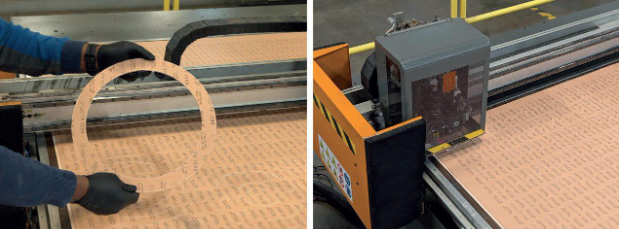
A depiction of the fabrication process for TEADIT®’s TF1590 gasket solution.
Why Modern Gasket Designs Matter
In critical heat exchanger applications, traditional gaskets, such as double-jacketed and spiral wound designs, are increasingly being replaced by more advanced solutions, notably corrugated metal, kammprofile gaskets or recovery type gaskets.
Despite their continued widespread use, traditional gasket designs often fall short in demanding environments. “A shocking number of them are still used every day despite the fact that technology has vastly improved,” Robbie noted. Their limitations, particularly in handling flange imperfections and maintaining seal integrity under stress, make them less suitable for high-critical services.
Modern designs address these shortcomings through innovative construction. Both corrugated metal and kammprofile gaskets combine a metallic core with a soft sealing layer, typically graphite or PTFE. This hybrid approach offers the strength to withstand pressure and temperature fluctuations while maintaining effective sealing. For example, the TEAIDT® 907 gasket has been engineered to combine these features to provide a high-recovery solution that maintains a reliable seal in thermal or mechanical cycling applications.
A key advantage lies in their ability to handle radial shear, which is the movement between flanges caused by thermal expansion and contraction. “There is nothing static about that piece of equipment,” Mark explained, challenging the common perception of bolted joints. As flanges expand and contract, the gasket must accommodate movement without losing integrity.Kammprofile gaskets, such as TEADIT® 942 and TEADIT® 946, achieve this through a serrated metal core. These serrations create alternating high- and low-stress zones that trap the sealing material, preventing it from migrating under shear forces. “There are saw tooth profiles that create dams or barriers to hold the graphite in place,” stated Mark.
Corrugated metal gaskets operate on a similar principle, using a wave-like structure to create stress distribution and maintain sealing performance. Both designs enable the use of sealing materials such as graphite and PTFE, which facilitate movement while maintaining tightness.
The result is a gasket that not only seals effectively but also adapts to the dynamic conditions inherent in heat exchanger operation.
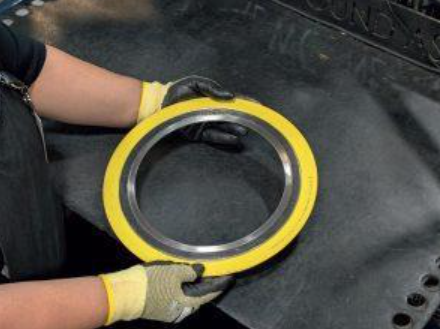
TEADIT® sealing experts engineering a metallic gasket.
Solving Problems In The Field
The benefits of advanced gasket technology are perhaps best illustrated through real-world applications. One recent case involved a refurbished heat exchanger that failed hydrostatic testing due to flange imperfections. The traditional semi-metallic gasket designs could not accommodate the uneven sealing surface, leading to leakage. Rather than resorting to time-consuming and costly flange re-machining, TEADIT® implemented an innovative diagnostic approach. A kammprofile gasket with a thick expanded PTFE layer was installed and then removed to map areas of compression.
This simple yet effective method revealed high and low points across the flange surface. With this information, the team used gasket tape to shim the low areas, creating a more uniform sealing surface. The solution avoided the need for specialized measurement equipment, reduced downtime, and enabled successful sealing.
Mark highlighted the broader significance. “The amount of cost associated with downtime always outweighs the cost of anything associated with a bolted flange joint. By addressing both the gasket and the system in which it operates, reliability was restored without extensive rework.”Such examples highlight a critical principle. Gasket performance cannot be isolated from the condition of the flange, the quality of installation, or the overall system design. Success lies in integrating all these elements into a cohesive solution.
Efficiency, Emissions, and Innovation
As industries pursue greater efficiency and lower emissions, gasket technology is evolving to support these goals. One major area of advancement is in analytical tools and engineering methodologies. Modern standards and practices, including advanced flange analysis and thermal modeling, enable more accurate prediction of joint behavior under real operating conditions. Robbie reiterated the importance of this holistic approach. “The wrong gasket can absolutely cause a leak. The right gasket does not solve the leak all on its own. It is part of a system.” Understanding the system through simulation, testing, and expertise is essential for optimizing performance.
Emerging gasket technologies are also focusing on enhanced recovery characteristics, allowing joints to maintain sealing integrity during thermal cycling. Even small improvements in recovery can significantly impact long-term reliability.
At the same time, quality control and manufacturing precision remain fundamental. For kammprofile gaskets, the exact geometry of serrations determines how well the sealing material densifies and performs. Deviations can compromise sealing effectiveness, highlighting the importance of tight tolerances and robust quality assurance.
TEADIT® recognized the importance of the serration profile and determined that the common methodology of inspecting serrations with go/no-go gauges, depth finder, and/or optical comparator was not enough. As a result, TEADIT® invested in the ability to inspect serrations with the accuracy needed to determine compliance with ASME B16.20, despite the required small tolerances. Beyond preventing leakage and hydrocarbon release into the atmosphere, gasket performance directly influences heat exchanger efficiency. Improper rib placement or internal leakage can allow fluid to bypass intended flow paths, reducing heat transfer effectiveness. This inefficiency forces operators to compensate by increasing energy input, often through additional fuel consumption. In this way, gasket technology plays an indirect but vital role in sustainability by supporting energy efficiency and reducing environmental impact.
The Foundation of Reliability
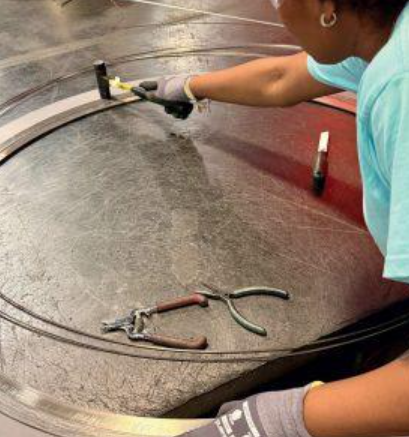
TEADIT® sealing experts engineering a metallic kammprofile gasket.
Despite the technological advancements, both Mark and Robbie stress the enduring importance of fundamentals. Availability of the correct materials, accurate gasket dimensions, and full traceability are essential for ensuring reliability, particularly during time-critical maintenance events such as plant turnarounds.
“Proper installation is also important,” stated Robbie. That is why TEADIT® supports proper installation through training and engineering services for both plant personal and mechanical contractors.
This emphasis on fundamentals echoes a broader philosophy. Drawing on a sports analogy, Mark noted.The conversation with TEADIT® reveals a clear shift in perspective. Gaskets are no longer peripheral components. They are central to the performance, reliability, and sustainability of heat exchangers. Treating them as commodities is no longer viable in an industry defined by efficiency demands and environmental responsibility.
By integrating advanced gasket technologies, applying rigorous engineering analysis, and maintaining a strong focus on fundamentals, operators can unlock significant gains in reliability and efficiency. The message is both simple and profound. Small components can have a large impact. And perhaps it is time, as Mark acutely suggested, to give gaskets the respect they deserve.
 About the Expert
Mark Ruffin is the Vice President of Sales and Engineering at TEADIT® , bringing over a decade of expertise in sealing technology and engineering solutions.
 About the Expert
Robbie Riggs is the President & CEO of TEADIT® North America. Robbie is passionate about developing customer-focused teams, driving market share growth, and positioning TEADIT® as the manufacturer focused on sealing for a safer and greener tomorrow.